
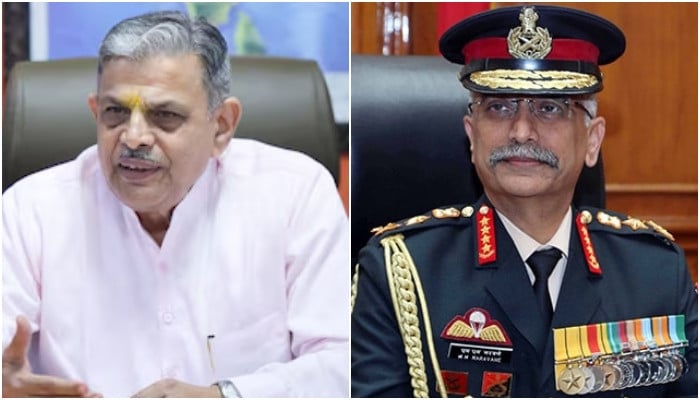
In a significant development that has stirred political debate in New Delhi, a leader of the Rashtriya Swayamsevak Sangh (RSS) and a former Indian army chief have jointly advocated for maintaining open diplomatic channels and people-to-people contact with Pakistan. The remarks signal a nuanced stance from within the ideological core of the ruling establishment, even as bilateral relations remain deeply strained following recent armed clashes.
Dattatreya Hosabale, the General Secretary of the RSS and widely considered the organization’s second-most powerful figure, stated unequivocally that India must not sever its diplomatic lifeline with Islamabad. The RSS functions as the ideological parent of the ruling Bharatiya Janata Party (BJP).
Diplomatic Window Must Remain Open
In an interview with the Press Trust of India, Hosabale argued that pragmatism should override hostility. He stressed that routine bilateral mechanisms must be preserved to allow for future reconciliation.
“India should always be ready to engage in dialogue with Pakistan. That is why diplomatic relations are maintained, trade and commerce continue, and visas are being given. So we should not stop these, because there should always be a window for dialogue,” Hosabale was quoted as saying.
The RSS leader invoked the legacy of former Prime Minister Atal Bihari Vajpayee, a towering figure in the BJP’s history, to bolster his argument. He specifically referenced Vajpayee’s historic bus journey to Lahore as a hallmark of peace outreach despite prevailing tensions.
“Everything has been tried, but more such efforts should continue. Atal ji tried to engage them in dialogue. He went to Lahore by bus, and many things have happened. [Modi] also invited Pakistan at the time of taking oath,” Hosabale added, highlighting a pattern of Indian-initiated overtures.
Echoes from the Military Brass
These sentiments were immediately reinforced by retired General Manoj Mukund Naravane, who previously served as the Chief of the Army Staff. Speaking to the media on Wednesday, Naravane shifted the focus from strategic ambiguity to human connectivity.
“People-to-people connections and contacts are very important. Common people live on both sides of the border and face similar problems in daily life,” Naravane said. He noted that when friendships develop between citizens of rival nations, it naturally eases interstate friction and fosters a better atmosphere for diplomacy.
A History of Frozen Ties and Firefights
The calls for dialogue stand in stark contrast to the reality of the India-Pakistan relationship, which has remained largely frozen for years. Diplomatic engagement has stalled, and the Line of Control has witnessed recurrent volatility.
Most notably, the two nuclear-armed neighbors were embroiled in a brief but intense 87-hour conflict in May 2025. During that confrontation, Pakistan claimed to have downed eight Indian fighter jets, including four French-made Rafales, a Su-30, a MiG-29, and a Mirage 2000, alongside a high-value unmanned aerial system. The hostilities ceased on May 10 with a ceasefire brokered by the United States.
The history of aerial engagements also looms large. In February 2019, following a violation of Pakistani airspace by Indian aircraft, Pakistan retaliated and captured Wing Commander Abhinandan Varthaman, who was subsequently repatriated.
The coordinated messaging from a top RSS ideologue and a former military chief suggests a growing chorus within India’s strategic community that complete isolation of Pakistan may not serve long-term regional stability. However, the remarks have drawn sharp criticism from opposition parties, including the Congress, who view the sudden softening of rhetoric with suspicion given the recent bloodshed.


