
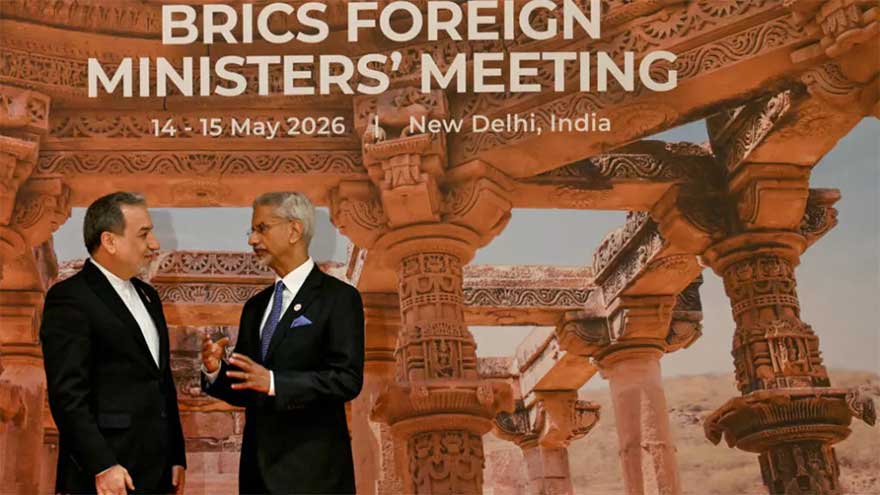
Foreign ministers from the expanded BRICS bloc convened in New Delhi on Thursday for crisis talks dominated by the spiraling Iran conflict and its cascading impact on fuel supplies, host India warned that the world order was entering a period of dangerous instability.
The two-day gathering brings together top diplomats from Iran, Russia, Saudi Arabia, and the United Arab Emirates—nations now bitterly divided by the military campaign launched against Tehran by the United States and Israel on February 28. India, holding the rotating BRICS chair, faces the delicate task of forging consensus among members with diametrically opposed stakes in the war.
“We meet at a time of considerable flux in international relations,” India’s External Affairs Minister Subrahmanyam Jaishankar told delegates in his opening address, before closed-door sessions began. “Ongoing conflicts, economic uncertainties, and challenges in trade, technology, and climate are shaping the global landscape.”
Strait of Hormuz Blockages Rattle Markets
Jaishankar warned that disruptions around Gulf shipping lanes and the Strait of Hormuz had triggered severe volatility in oil and gas markets, piling pressure on energy-importing economies across the developing world. India, the planet’s third-largest crude buyer, normally sources roughly half its oil through the narrow strait, which has been repeatedly blocked since hostilities erupted.
“Development issues remain central,” Jaishankar stressed. “Many countries continue to face challenges on energy, food, fertilizer and health security, as well as access to finance.”
Ship-tracking data reveals that New Delhi has scrambled to plug supply gaps by deepening ties with old partners and reviving dormant supplier relationships. The most critical backstop has been Russian crude—a fuel source India had spent much of the past year trying to reduce under stiff US tariff pressure.
Iranian Foreign Minister Abbas Araghchi and Russian counterpart Sergei Lavrov were both present at the table, underscoring the forum’s role as a rare diplomatic arena where Western adversaries and regional rivals sit side by side.
India Turns to Moscow as Global Order Frays
On Wednesday evening, Jaishankar held bilateral talks with Lavrov, signaling New Delhi’s pragmatic calculus in a fractured geopolitical landscape. “Our political cooperation is even more valuable in an uncertain and volatile global environment,” Jaishankar said after the meeting, noting that discussions covered “trade and investment, energy and connectivity.”
The Iran war has compounded strains on India’s economy, which relies heavily on Middle Eastern energy and fertilizer imports, clouding the country’s growth forecasts. The crisis has also exposed the vulnerabilities of emerging markets that BRICS was designed to champion.
Founded in 2009 by Brazil, Russia, India, China, and South Africa, the bloc has aggressively expanded its ranks to amplify the voice of the Global South. It now includes Egypt, Ethiopia, Iran, Saudi Arabia, Indonesia, and the UAE—a membership roster that mirrors the very fault lines running through the Middle East.
China’s Foreign Minister Wang Yi skipped the meeting, with US President Donald Trump visiting Beijing on the same day. The absence of the bloc’s most powerful member added another layer of complexity to the talks.
With deep divisions among members over the Middle East war and criticism of Western powers, it remained uncertain whether a joint statement would emerge. “We will let you know as things progress,” foreign ministry spokesman Randhir Jaiswal told reporters.
The foreign ministers are also scheduled to meet Prime Minister Narendra Modi, ahead of a leaders’ summit later this year that will test whether BRICS can translate its expanded weight into a genuinely stabilizing force.


